MoMO Galerie

Window for Curating Art Projects

Exhibition
« Stairway to Heaven » (Louise, a matter of life and death and happiness)

from 23th october to 5th december, 2010

by Romaric Tisserand


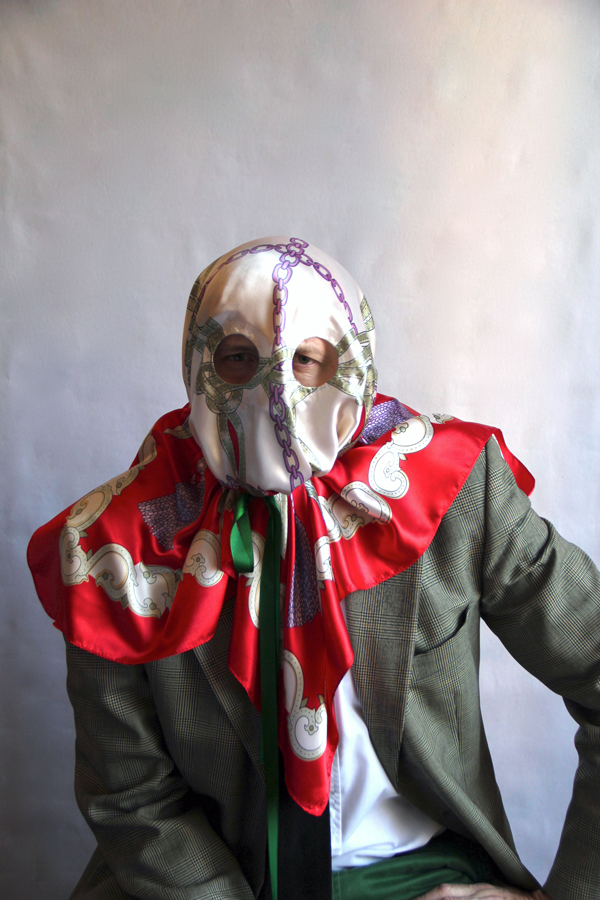
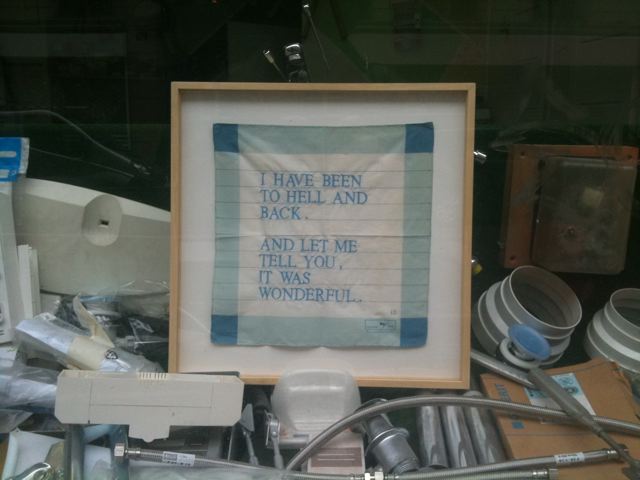
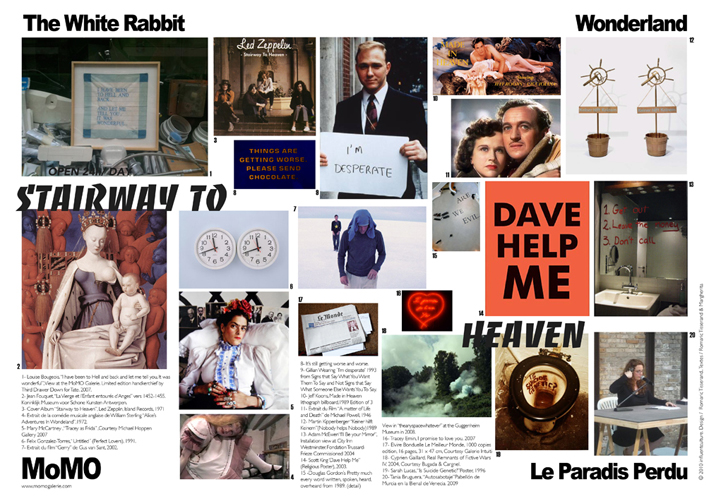
Louise Bougeois,  » I have been to hell and back and let me tell you it was wonderful », limited edition handkerchief  by Third Drawer Down for Tate, 2007 (view of the window of the MoMO galerie)

FACE A   » STAIRWAY TO HEAVEN  » (Welcome Patch in the window of the MoMO galerie) 2010

FACE B   » HELL / HELLO  » (Welcome Patch in the window of the MoMO galerie) 2010

An Exhibition propopsal from Romaric Tisserand

MoMo’s first exhibition, “Stairway to Heaven (Louise, Life, Death, and maybe Happiness)” took shape in the spring. We chose Louise Bourgeois’ embroidered handkerchief, “I’VE BEEN TO HELL AND BACK AND LET ME TELL YOU IT WAS WONDERFUL”, pinned to the wall like a Byzantine icon, as the “flag” of a universal quest for happiness and love of life that culminated with the artist’s departure on 30 May.

The title, ‘Stairway to Heaven’, is a dual, musical and cinematographic reference. In the legendary 1971 Led Zeppelin hit written by Jimmy Page and Robert Plant, “there’s a lady who’s sure that all that glitters is gold and she’s buying the stairway to heaven,” but at the end she’s told: “your stairway lies on the whispering wind…”

In ‘A Matter of Life and Death’, first released in the USA in 1946 as ‘Stairway to Heaven’, an RAF pilot (David Niven) jumps from his burning plane without a parachute. A guardian angel with a French accent takes him away to heaven, from where he nostalgically contemplates the world he has just left. Then one morning he wakes up on a beach and continues his life on earth, falling in love with June (Kim Hunter), refusing to return to heaven and escaping his guardian angel.

What still pushes us to chase after Lewis Caroll’s White Rabbit?

Cover Album “Stairway to Heaven”, Led Zepplin, Island Records, 1971

David Niven et Kim Hunter. Extrait du Film “A matter of Life and Death” de Michael Powell, 1946

In our constant quest for happiness, both the song and film lead us back to Louise Bourgeois’ embroidered work “I’ve been to Hell and back and let me tell you it was wonderful”, to her jubilant response to the trials of life, in which there is no heaven, hell or purgatory other than the one we create for ourselves. The idea of happiness can thus be understood as a path, as accomplishment, contradiction and desire.

Louise Bourgeois’ embroidered handkerchief, created in 1967, is a veritable self-portrait and a brazen celebration of life, telling us that in its organised chaos there is a kind of radiant lucidity.

Via a series of visual quotes, the Louise Bourgeois work in the MoMo window takes us on a journey into the bestiary of Alice in Wonderland, into the mythology of life, desire, the death of the artist and paradise lost.

Jean Fouquet, “La Vierge et l’Enfant entourés d’Anges” vers 1452-1455. Koninklijk Museum voor Schone Kunsten Antwerpen.

The Other World. Still of “A matter of Life and Death” de Michael Powell, 1946

Kim Hunter. Still of “A matter of Life and Death” de Michael Powell, 1946

Still of « Au hasard Balthazar » from director Robert Bresson’s film, 1966

Still from the Musical of William Sterling’s “Alice’s Adventures In Wondeland”,1972.

Vladimir Yaguno, el pie de seda ( la Habana ), 2002

(Eat Me) Pain aux Raison, Photo Romaric Tisserand, London 2010

Frida Khalo, My birth, 1932
Oil on metal. 31 x 35 cm. Private collection.

Mary McCartney
Tracey as Frida, 2007
C-type print
30 x 40 inches
Courtesy Michael Hoppen Gallery

Jeff Koons, Made in Heaven
lithograph billboard
125 x 272 inches
317.5 x 690.9 cm
Edition of 3 plus AP
1989 © Jeff Koons

James Turrell «First Moment» 2003, Courtesy Gagosian Gallery

Jenny Holzer, « Inflammatory Essays »
[no title] 1979-82.
Lithograph on paper
© TATE  Collection.

Henri Rousseau (dit le Douanier Rousseau), Le Rêve, 1910
Museum of Modern Art (MoMA), New York

Cyprien Gaillard, Real Remnants of Fictive Wars IV, 2004,
Courtesy Galerie Bugada & Cargnel.

Extrait du film “Gerry” de Gus van Sant, 2002. (Matt Damon et Casey Affleck).

Douglas Gordon’s Pretty much every word written, spoken, heard, overheard from 1989. (detail) View in “theanyspacewhatever” at the Guggenheim  Museum in november 2008.

Martin Kippenberger (1953-1997)   »Keiner hilft Keinem » ( Nobody helps Nobody)
each: incised with the artist’s initial and date ‘K 89′ (on the hammer) paint on composite board, plastic, bronze and copper, in two parts. Each: 59in. (150cm.) high.
Executed in 1989, this work is from an edition of three.
 » Personne n’aide personne / Nobody helps nobody / Keiner hilft keinem ( Lord Jim Lodge )

Adam McEwen
« I’ll Be your Mirror », 2004
Installation view at City Inn Westminster
Fondation Trussardi
Frieze Commissioned 2004

Elvire Bonduelle Le Meilleur Monde, (The Best World),
a 1000 copies edition, 16 pages,
31 x 47 cm
© 2010 the artist, courtesy Galerie Intuiti

Matt Stokes, 2003
„Real Arcadia“, 26.01.-08.03.2008
Detailansicht
Courtesy of Lüttgenmeijer, Berlin

« Be Stupid », Diesel Campaign, 2010

Gillian Wearing b. 1963 `I’m desperate’  1993
from Signs that Say What You Want Them To Say and Not Signs that Say What Someone Else Wants You To Say.

Happy New Year,HelpYouselves If you can. Photo Lili Bonnet

Les Damnés, Porche du Beau Dieu ( détail ), Cathédrale de Reims, XIII siècle

Felix Gonzalez-Torres, « Untitled´ (Perfect Lovers), 1991.

Julia Chiang
I am So Sorry
2009
ink on index card
3 x 5  »
Edition of 100, each unique
Signed & numbered on back

DAMIEN HIRST
Problem Girl, 2001
Glass, stainless steel, plasterzote and medical packaging
70 13/16 x 35 3/8 x 14 3/16 inches (179.8 x 89.9 x 36 cm)
Courtesy Gagosian Gallery.

TRACEY EMIN, I promise to love you, 2007
Clear red neon. 145.8 x 143 cm. (57 x 56 in).   This work is from an edition of three plus two artist’s proofs and is accompanied by a certificate of authenticity signed by the artist.

»Rock My Religion«, 1982-1984 by Dan Graham. Video Monocanal, Betacam.
Colleccio MACBA. Fundacio Museu d’Art Contemporani de Barcelona. Donacio Familia Romeu

Louise Bourgeois, « Untitled » from « Fugue »,
2003 (published 2005).
One from a portfolio of nineteen screenprints with lithography, composition (irreg.): 11 13/16 x 14 11/16″ (30 x 37.3 cm); sheet: 11 13/16 x 16″ (30 x 40.7 cm). Publisher and printer: Procuniar Workshop, New York. Edition: 9. Gift of the artist to MoMA. © 2010 Louise Bourgeois Trust

Scott King ’Never Work!’
First Published November 1998 In Sleazenation
‘Dave Help Me (Religious Poster)


Sarah Lucas
Is Suicide Genetic?
1996
Photograph on paper

Tania Bruguera, Autosabotaje
el Pabellón de Murcia en la Bienal de Venecia
2009


Ana Mendieta: Untitled - 1973
© Estate of Ana Mendieta

Meta Warrick Fuller. Talking Skull. 1937.Bronze, 28 x 40 x 15 inches
Museum of Afro American History, Boston


Hippolyte Bayard : Autoportrait, « le noyé », positif direct sur papier, octobre 1840
Société française de Photographie, Paris


On Kawara, One Million Years (Past and Future), since 1970


Jane Hilton, Coming soon nothing, Dayton, Nevada, 2002, © the artist

Jane Hilton, Coming soon nothing, Dayton, Nevada, 2002, © the artist

Alice in Wonderland is the story of a world equal to our desires, of a childhood that submits to no one. A world in which logic and knowledge are obsolete, in which intuition still takes precedence, in which the passage from reality to fiction is the fertile ground for unbridled imagination.

Like Lewis Caroll, Louise Bourgeois’ drew on her childhood, on those total experiences that forge our definitive relationship to the world from the very beginning. The construction of the myth of the artist is a response to the notion of death as desire for immortality. Art and life are indissociable in Louise’s work, just as dream and reality are in Alice’s adventures. Frida Khalo, Ana Mendieta, Louise Bourgeois, Tania Bruguera and Marina Abramovic all created the figure of the primitive, Dionysian, anthropophagic ‘woman-matrix’ consuming their entire life.

Louise Bourgeois reactivated her childhood memories for her own ends, to shape her work, sewing and darning together her own sculptural “bestiary” in which ‘Mother’ is a gigantic spider and her father a phallic statue to be held in the hand. Alice gets lost in her frantic, careless pursuit of the White Rabbit, shrinking when she drinks from a little bottled labelled Drink Me, and growing when she eats biscuits marked Eat Me, but on the other side of Louise’s looking glass (her inner life/world), she is no longer a mere pawn but Queen. Alice has to run to stay still in an upside-down camera obscura world in which to reach the garden she must first distance herself from it, whereas Louise Bourgeois’ thread restores and reconstructs the warp and weft.

In Fellini’s 8 ½, the film director (Marcello Mastroianni) is asked by one of the doctors at the spa: “What are you working on now? Another film without hope?” ( su cosa stai lavorando in questo momento? ancora su un film senza speranze? )

What do we have left to give our choices and determination shape?  Hope and wandering are the most complete forms of freedom – if practiced until exhaustion. A freedom that makes one tremble because it is total, immediate, irrevocable. Jim Jarmush’s 1984 film “Stranger Than Paradise” tracks the collective roaming of three misfits. But the most accomplished work on this theme is Gus Van Sant’s “Gerry”, in which two friends get lost on a hike in the desert. Their journey quickly degenerates into a dance of death in which they forget the aim of their quest and the struggle of Cain and Abel is put to the test of mankind’s origins and mythology. And ultimately leads to the breakdown of friendship and the triumph of the void, fear and the sun, symbol of death.

‘Nobody helps Nobody’, Martin Kippenberger

There remains desire and pain, those transformers of reality, the emotional disequilibrium that shuts us up in solitude and frees us from thinking, calculating… Life must always be given meaning. But what meaning? Rationality will not save us – I Love you, I Hate you, I Promise you, I forget you. But above all not remembering and finally accepting the life one dreads.

In ‘Brave New World’ Aldous Huxley, explores mankind’s greatest affliction: not that we prefer to laugh rather than think, but that we do not know why we laugh and why we’ve stopped thinking. The SOMA pills handed out at the end of each workday induce a state in which all desires are annihilated by an immediate, aimless pleasure in which we are dead because we no longer want anything. No more hope, no more desire.

Jean BAUDRILLARD talks of an ‘integral reality’, the ultimate stage of a totally calculable and operational society at odds with the traditional principle of reality. A world in which everything is technically possible, in which all desires and Utopias are achievable.

Behind the fantasy of immortality feigning death looms the prospect of an aimless path, of happiness without desire, of a story that would proliferate indefinitely, without bounds, without choices because everything is possible. In which happiness has disappeared and left us in darkness.

No more Garden of Eden, no more rules to disobey.

Alexandre Arrechea, « Garden of Mistrust », Watercolor on Paper, 44 x 44 inches
Aluminum, surveillance cameras, computer equipment (
Project website )
©  Alexandre Arreachea

Contradiction will be our evolution.

Cyprien Gaillard, Desniansky Raion & Koudlam – See you All
2007
30:00 min.
Edition of 5

Abramovic, Marina and Ulay, «Light/Dark», 1977
Video Still


Until now, tout va bien.

“– It’s the same old story. Again we’re being sold the future.

- Don’t worry, the solution is Utopian. Take a good look around you. But who…who loves life?

- Once upon a time people were happy because they didn’t understand why they were happy.

- Now, they’re no longer happy because everyday their happiness is explained to them.”

(Nouvelle Vague, Jean-Luc Godard, 1990)


To be imperfect, free and happy.


Romaric Tisserand

Paris,  23th october, 2010

( Traduction David Wharry )